|
MS ISO 9001:2015 Quality Management System Requirements - Standards (Second Revision)
For Training Purposes
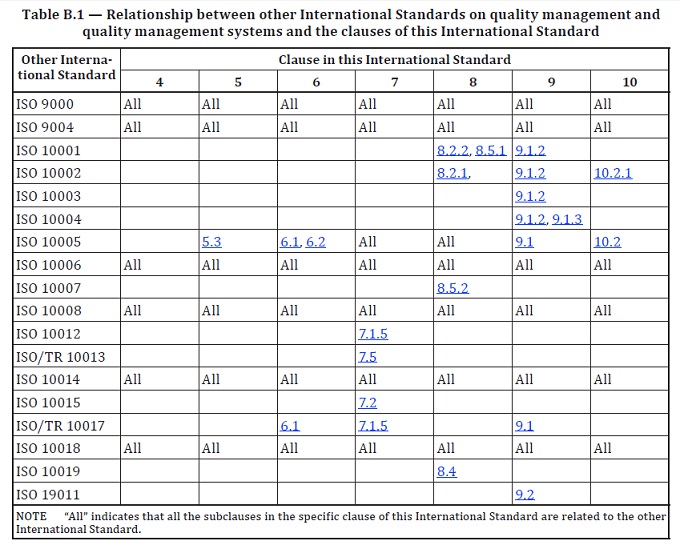
Annex B (informative) Other International Standards on quality management and quality management systems developed by ISO/TC 176 The International Standards described in this annex have been developed by ISO/TC 176 to provide supporting information for organizations that apply this International Standard, and to provide guidance for organizations that choose to progress beyond its requirements. Guidance or requirements contained in the documents listed in this annex do not add to, or modify, the requirements of this International Standard. Table B.1 shows the relationship between these standards and the relevant clauses of this International Standard. This annex does not include reference to the sector-specific quality management system standards developed by ISO/TC 176. This International Standard is one of the three core standards developed by ISO/TC 176. — ISO 9000 Quality management systems — Fundamentals and vocabulary provides an essential background for the proper understanding and implementation of this International Standard. The quality management principles are described in detail in ISO 9000 and have been taken into consideration during the development of this International Standard. These principles are not requirements in themselves, but they form the foundation of the requirements specified by this International Standard. ISO 9000 also defines the terms, definitions and concepts used in this International Standard. — ISO 9001 (this International Standard) specifies requirements aimed primarily at giving confidence in the products and services provided by an organization and thereby enhancing customer satisfaction. Its proper implementation can also be expected to bring other organizational benefits, such as improved internal communication, better understanding and control of the organization’s processes. — ISO 9004 Managing for the sustained success of an organization — A quality management approach provides guidance for organizations that choose to progress beyond the requirements of this International Standard, to address a broader range of topics that can lead to improvement of the organization’s overall performance. ISO 9004 includes guidance on a self-assessment methodology for an organization to be able to evaluate the level of maturity of its quality management system. The International Standards outlined below can provide assistance to organizations when they are establishing or seeking to improve their quality management systems, their processes or their activities. — ISO 10001 Quality management — Customer satisfaction — Guidelines for codes of conduct for organizations provides guidance to an organization in determining that its customer satisfaction provisions meet customer needs and expectations. Its use can enhance customer confidence in an organization and improve customer understanding of what to expect from an organization, thereby reducing the likelihood of misunderstandings and complaints. — ISO 10002 Quality management — Customer satisfaction — Guidelines for complaints handling in organizations provides guidance on the process of handling complaints by recognizing and addressing the needs and expectations of complainants and resolving any complaints received. ISO 10002 provides an open, effective and easy-to-use complaints process, including training of people. It also provides guidance for small businesses. — ISO 10003 Quality management — Customer satisfaction — Guidelines for dispute resolution external to organizations provides guidance for effective and efficient external dispute resolution for product-related complaints. Dispute resolution gives an avenue of redress when organizations do not remedy a complaint internally. Most complaints can be resolved successfully within the organization, without adversarial procedures. — ISO 10004 Quality management — Customer satisfaction — Guidelines for monitoring and measuring provides guidelines for actions to enhance customer satisfaction and to determine opportunities for improvement of products, processes and attributes that are valued by customers. Such actions can strengthen customer loyalty and help retain customers. — ISO 10005 Quality management systems — Guidelines for quality plans provides guidance on establishing and using quality plans as a means of relating requirements of the process, product, project or contract, to work methods and practices that support product realization. Benefits of establishing a quality plan are increased confidence that requirements will be met, that processes are in control and the motivation that this can give to those involved. — ISO 10006 Quality management systems — Guidelines for quality management in projects is applicable to projects from the small to large, from simple to complex, from an individual project to being part of a portfolio of projects. ISO 10006 is to be used by personnel managing projects and who need to ensure that their organization is applying the practices contained in the ISO quality management system standards. — ISO 10007 Quality management systems — Guidelines for configuration management is to assist organizations applying configuration management for the technical and administrative direction over the life cycle of a product. Configuration management can be used to meet the product identification and traceability requirements specified in this International Standard. — ISO 10008 Quality management — Customer satisfaction — Guidelines for business-to-consumer electronic commerce transactions gives guidance on how organizations can implement an effective and efficient business-to-consumer electronic commerce transaction (B2C ECT) system, and thereby provide a basis for consumers to have increased confidence in B2C ECTs, enhance the ability of organizations to satisfy consumers and help reduce complaints and disputes. — ISO 10012 Measurement management systems — Requirements for measurement processes and measuring equipment provides guidance for the management of measurement processes and metrological confirmation of measuring equipment used to support and demonstrate compliance with metrological requirements. ISO 10012 provides quality management criteria for a measurement management system to ensure metrological requirements are met. — ISO/TR 10013 Guidelines for quality management system documentation provides guidelines for the development and maintenance of the documentation necessary for a quality management system. ISO/TR 10013 can be used to document management systems other than those of the ISO quality management system standards, e.g. environmental management systems and safety management systems. — ISO 10014 Quality management — Guidelines for realizing financial and economic benefits is addressed to top management. It provides guidelines for realizing financial and economic benefits through the application of quality management principles. It facilitates application of management principles and selection of methods and tools that enable the sustainable success of an organization. — ISO 10015 Quality management — Guidelines for training provides guidelines to assist organizations in addressing issues related to training. ISO 10015 can be applied whenever guidance is required to interpret references to “education” and “training” within the ISO quality management system standards. Any reference to “training” includes all types of education and training. — ISO/TR 10017 Guidance on statistical techniques for ISO 9001:2000 explains statistical techniques which follow from the variability that can be observed in the behaviour and results of processes, even under conditions of apparent stability. Statistical techniques allow better use of available data to assist in decision making, and thereby help to continually improve the quality of products and processes to achieve customer satisfaction. — ISO 10018 Quality management — Guidelines on people involvement and competence provides guidelines which influence people involvement and competence. A quality management system depends on the involvement of competent people and the way that they are introduced and integrated into the organization. It is critical to determine, develop and evaluate the knowledge, skills, behaviour and work environment required. — ISO 10019 Guidelines for the selection of quality management system consultants and use of their services provides guidance for the selection of quality management system consultants and the use of their services. It gives guidance on the process for evaluating the competence of a quality management system consultant and provides confidence that the organization’s needs and expectations for the consultant’s services will be met. — ISO 19011 Guidelines for auditing management systems provides guidance on the management of an audit programme, on the planning and conducting of an audit of a management system, as well as on the competence and evaluation of an auditor and an audit team. ISO 19011 is intended to apply to auditors, organizations implementing management systems, and organizations needing to conduct audits of management systems. |
||
 |
||
|
|